
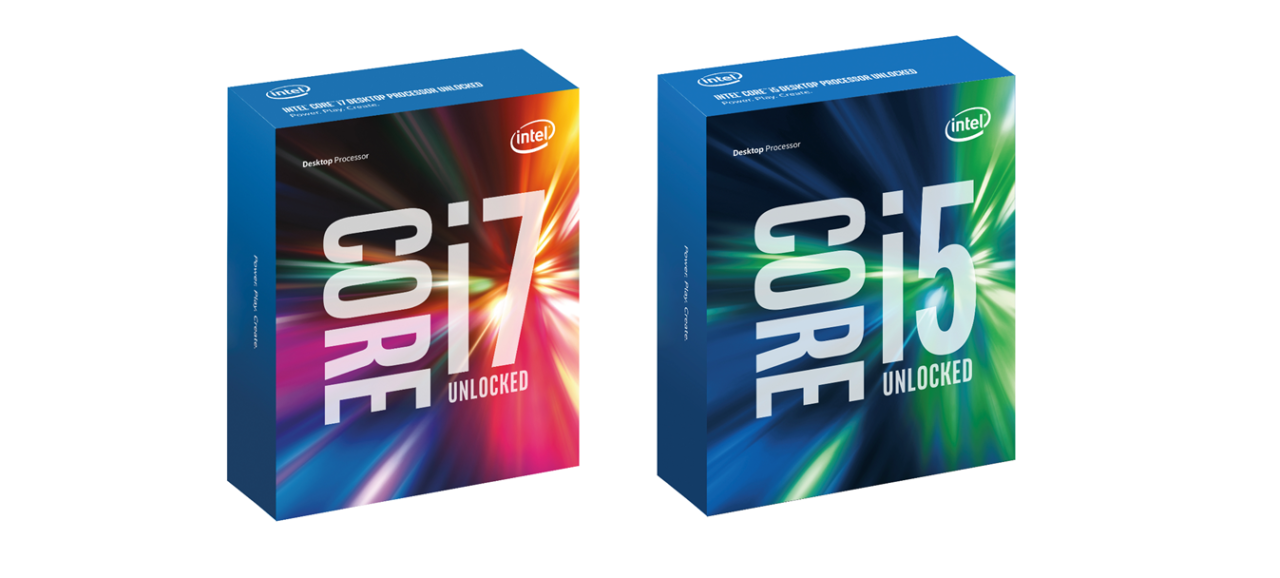
Intel’s latest CPU family, Skylake, has just launched with two new CPUs (the i5-6600K and i7-6700K), a new socket (1151), and a new chipset family for motherboard (Z170). These CPUs are on the 14nm manufacturing process, which is not strictly new (their previous generation, Broadwell, was on 14nm dies), but new when it comes to mass-market availability.
How well do these new CPUs perform? After analyzing reviews (linked below), it looks as though, unfortunately, Intel has decided to forgo CPU improvements and focus on the integrated GPU.
The new CPUs see a very small improvement (~5-6%) over the previous generation, and the power consumption and overclocking improvements are hardly worth mentioning. The new CPUs do support DDR4, but the tests show that the differences between DDR3 and DDR4 performance are still small. DDR4 is also still more expensive than DDR3, so keep that in mind if price matters to you.
The two new CPUs are in a configuration and price that has remained consistent for new Intel launches since around 2009: A quadcore without hyperthreading in the $200-$250 range (the i5-6600K), and a quadcore with hyperthreading in the $300-$350 range (the i7-6700K). This has been the case with the original i5-750 and i7-950, and repeated with the 2500K/2600K, the 3570K/3770K, and the 4670K/4770K.
Six years is a very long time, so why does Intel continue to give the same configuration, instead making it a hexacore or octocore CPU? There are two reasons:
- The focus on the integrated GPU. With Broadwell, the iGPU took roughly 50% of the die. Intel has not yet released Skylake die shots, but we expect that a very large portion of the die has been given to the iGPU, instead of adding CPU cores.
- Lack of competition. In the discrete CPU world, it is not a “two horse race” between Intel and AMD, but more of a “one horse, one duck” race. When it comes to high-end CPUs, Intel does not need to improve because it is already winning by a mile.
This leaves us in the unfortunate position of only being able to recommend these new CPUs to those who are wealthy, and those who are performance enthusiasts. The minor gains, combined with the expensive DDR4 requirements, mean that Skylake is not enjoying a very groundbreaking launch.
AMD is expected to launch its new Zen CPUs next year, also likely to be on a 14nm, and hopefully with a large performance increase over the embarrassing Bulldozer. We hope it can exceed our expectations.
For now, Intel will continue its unopposed dominance over the high-end CPU segment. We will be adding Skylake CPUs to our Enthusiast tier when it is available for purchase. Skylake will probably appear in lower tiers too, when DDR4 prices come down even further, or when Haswell CPUs are no longer available.
Reviews and analysis:
Duckling:

7 Comments
You can post comments in this post.
Intel seems to be having a lot of trouble with their 14nm process. Hopefully the next tock will bring increased performance, and hopefully AMD’s zen is more competitive!
Orion 11 years ago
As DirectX 12 and Vulcan begin utilizing all of their cores, will the performance gaps between the different generations of Intel CPU’s become more pronounced or will they remain relatively unchanged?
Ryan Kelly 11 years ago
Hello! I hope you don’t mind if I input a bit of an opinion.
Firstly, it depends on the CPU. A high-end i5 or an i7 should run really well for years, especially with overclocking. But it’s true that if games are able to make better use of the CPU then the CPU simply becomes a more important part of gaming computers. This seems to be the case with DirectX 12 and Vulcan, though it is hard to know the amount to which you will see a performance gap between CPU generations until they are out and being tested.
Matthew Zehner 11 years ago
Forget AMD, Intel itself is it’s own worst competition in the PC space. Nehalem quads are no less than 7 years old by this point yet they still have no real trouble running current games today, much less surfing the net, MS Office and stuff. The last thing Intel wants is introducing even more future competition with itself with a mainstream 6 or 8 core chip now.
Exploited 11 years ago
It has been 4 months, is there any chance this socket is going to be better for futureproofing a machine, or shall I just stick with 1150? I’m shooting to spend less than $900.
Gavin E 11 years ago
You would most likely be totally fine sticking with LGA 1150!
Matthew Zehner 11 years ago
Post A Reply