
Bend the rules (and the GPU shroud design) with the new AMD Radeon RX 5700 XT. There’s technically 2 versions of this card, so let’s get into some details before we build us a PC with it for gaming!

Bend the rules (and the GPU shroud design) with the new AMD Radeon RX 5700 XT. There’s technically 2 versions of this card, so let’s get into some details before we build us a PC with it for gaming!

Are you seeing all of these Ryzen releases and thinking, “Everything is still too expensive!” Or even, “I just want to play Fortnite and CS:GO at 1080p, I don’t need all this!” Well, do we have the processor for you. Well, AMD does—in the form of the Ryzen 5 3400G.

The AMD Ryzen 9 3900X is (at least for now) the flagship CPU from the new range from AMD. With its huge 12-cores and 24-threads, it has ‘productivity king’ written all over it. So let’s look at building a productivity powerhouse system with it!

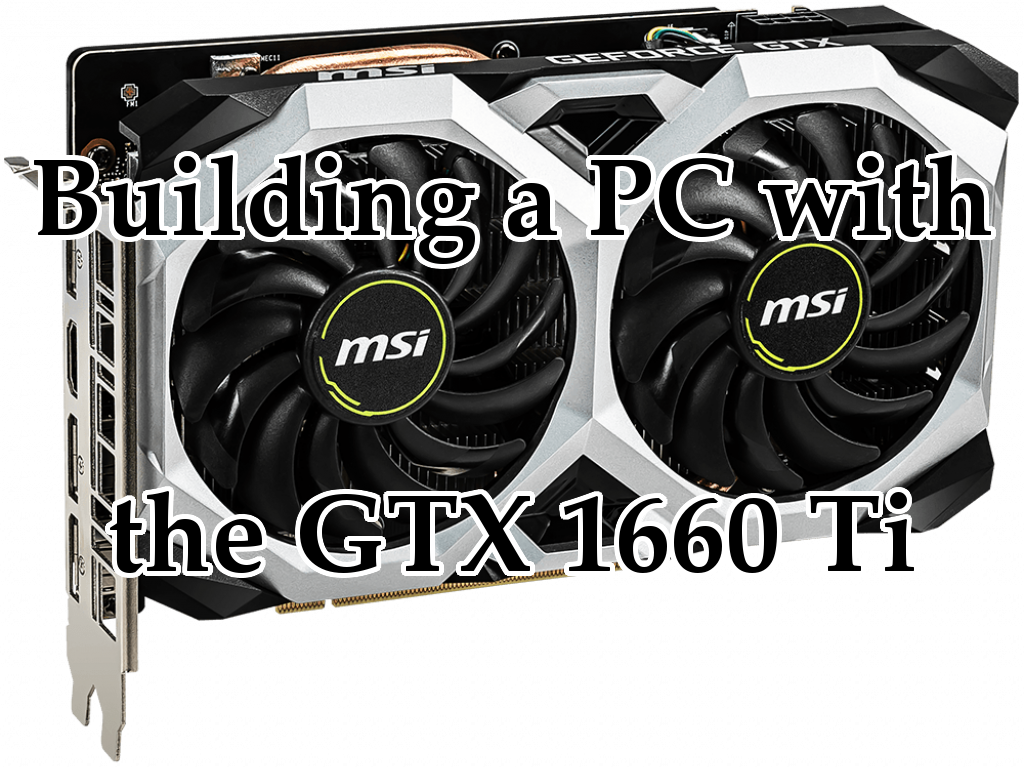
NVIDIA’s newly-released GTX 1660 Ti behaves almost like a new and improved GTX 1070. It comes with the new Turing architecture found in the RTX series, but without the ray-tracing and Deep Learning Super Sampling technology; these premium features are still in the early stages of adoption, and aren’t useful or economical for a mid-tier GPU. The GTX 1660 Ti offers the advantages of new architecture without the expense and burden of superfluous features.
The GTX 1660 Ti achieves framerates at resolutions and settings roughly comparable to the GTX 1070. It doesn’t reach the level of a GTX 1080, but it’s an affordable upper-mid-range graphics card that will meet the needs of gamers and digital artists alike.
What would a versatile, powerful, balanced PC build look like with this GPU?

With the launch of the 2nd-generation Threadripper 2950X, we of course had to look at what would make a balanced PC with this 16-core beast!

AMD are coming out swinging, and they’re out for Intel’s blood with the flagship Threadripper 2990WX! With a bonkers 32 cores and 64 threads, this is not a CPU for the casual gamer; it’s a workstation powerhouse, designed for when multi-core performance is king.

Last year was an amazing one for AMD, with the company releasing a slew of extremely successful new CPUs based on the Zen architecture. This year is getting off to a decent start as well—with a new line of Ryzen CPUs with integrated Vega graphics processors (the R3 2200G and R5 2400G) being launched earlier this week. In this article, we will look at how well these freshly released processors fare against Intel’s integrated graphics, Nvidia’s low-budget GT 1030, and AMD’s own earlier APU integrated graphics.

A Ryzen CPU and an Intel CPU. Which system is a better value if we compare the full PC?
In the past few months, we have written comparison after comparison of AMD’s very successful Ryzen CPU series to Intel’s ultra-fast 8th generation Coffee Lake chips. (For a quick recap, here are a few: Ryzen 7 1700 vs Core i7-7700K and vs Core i7-8700K, Ryzen 5 1600 vs Core i5-7600K and vs Core i5-8600K.)
These processors are often comparable in terms of price and performance, but building a complete PC is a different story. In this article I will show the differences between two comparable Intel and AMD Ryzen systems, based on the i7-8700K and Ryzen 7 1700 respectively.

Intel’s Coffee Lake CPU stack
Intel’s new Coffee Lake processors have been very competitive with AMD’s Ryzen, as we previously pointed out in our i7-8700K and i5-8600K comparisons against the competition.
Finally, we turn our attention to the 4-core 4-thread i3 line. In this article, I’ll be comparing what we know about the i3-8350K against AMD’s price equivalent, the Ryzen 5 1500X. Intel’s segmentation has gone quite out of hand though, and the 6-core 6-thread i5-8400 falls into the same price category, costing only around $10 more than the 8350K and 1500X.
So, how do these sub-$200 processors compare in gaming and some light productivity work?

The final piece in AMD’s 7th generation CPU refresh for the AM4 platform comes in the form of three new Athlon processors: the X4 940, X4 950, and X4 970. Unlike the two sets of A-series CPUs (see our 35W and 65W builds), these new Athlons do not come with onboard GPUs.
The advantage, however, is that these are unlocked cores and can be overclocked much harder. So read on to find out exactly what you can build with the new AMD Athlon chips!